
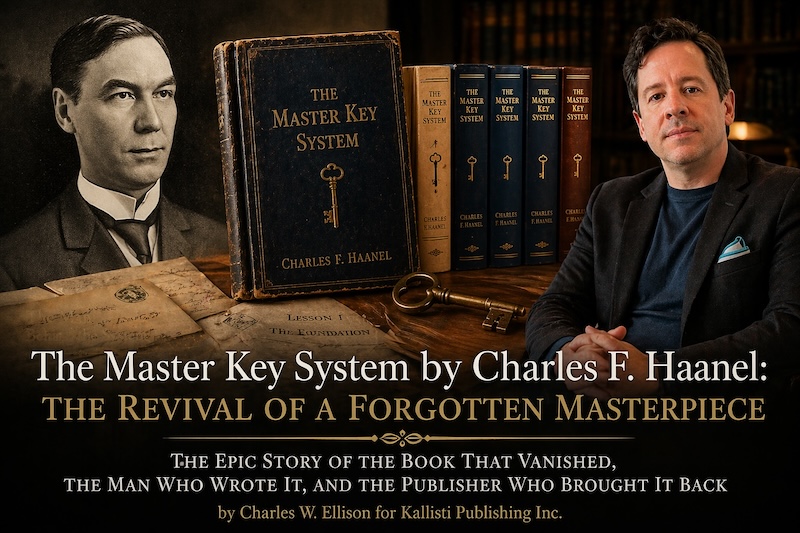
The Master Key System by Charles F. Haanel : The Revival of a Forgotten Masterpiece
The Epic Story of the Book That Vanished, the Man Who Wrote It, and the Publisher Who Brought It Back
by Charles W. Ellison for Kallisti Publishing Inc.
It is the twenty-seventh of November, 1949. In St. Louis, Missouri, a city Charles F. Haanel had called home for most of his adult life, the man himself is laid to rest in Bellefontaine Cemetery, a quiet, wooded expanse on the city’s north side where the graves of industrialists, civic titans, and men of consequence have always had a way of disappearing into the elm shade and the moss. Mr. Haanel was eighty-three years old. He had been a businessman of considerable standing, a writer of singular ambition, and the author of what he believed — and what a significant number of people who encountered it believed, then and since — to be one of the most practically useful documents on the subject of human thought and its relationship to human achievement ever composed in the English language.
That document was The Master Key System.
And in a very real sense, the day Charles F. Haanel was buried was the day it began to disappear.
Not immediately. Not all at once. The ideas within the work were already circulating through the nervous system of American self-help culture in ways that Mr. Haanel’s successors and imitators would rarely acknowledge and almost never credit.
But the book itself — the text as a unified, coherent, rigorously structured whole — would spend the second half of the twentieth century slipping steadily out of reach. The correspondence course apparatus that had originally brought it to students dissolved with the generation that had operated it. The commercial infrastructure that had sustained its distribution evaporated. And by the 1980s and into the 1990s, finding a proper edition of The Master Key System required either remarkable luck or access to a research library with unusually broad holdings.
For all practical purposes, one of the most consequential works of its era had gone dark.
It would take fifty years, and one attentive publisher, to turn the lights back on.
The Man Who Unlocked the World
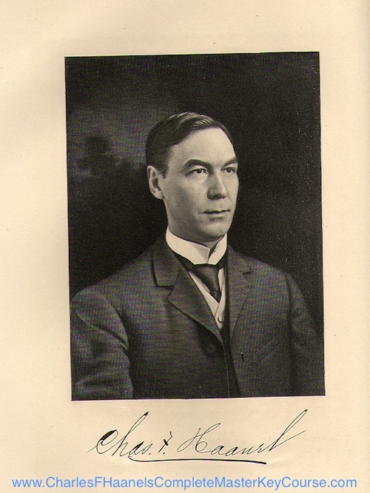
To understand why The Master Key System endures, it helps first to understand the man who wrote it, which requires setting aside the familiar image of the personal development guru — the platform speaker, the seminary-trained philosopher, the professional exhorter of crowds.
Charles F. Haanel was none of these things. He was a businessman who was thoroughly and roundly educated. He had built his life and his considerable fortune through commerce, industry, agriculture, and land development, operating in the mercantile world of St. Louis during one of the most consequential periods in that city’s history.
Born in Ann Arbor, Michigan, in 1866, Mr. Haanel came of age in the Gilded Age and built his career through the Progressive Era, accumulating not only wealth but the kind of practical authority that comes from decades of getting things done in the real world.
This background matters enormously. Mr. Haanel did not write about the principles of success from a position of theoretical aspiration. He wrote from the vantage point of a man who had organized businesses, managed men, developed land, navigated markets, and observed, over many years, which habits of mind produced results and which did not. His philosophy was not assembled from borrowed ideas and rhetorical ambition — though it did draw, openly and deliberately, from a serious tradition.
The intellectual and spiritual foundation of The Master Key System, and of virtually everything Mr. Haanel wrote, was Christian Science, the metaphysical movement established by Mary Baker Eddy in the latter half of the nineteenth century and one of the most consequential religious and philosophical forces in American life by the time Mr. Haanel began his writing career.
Christian Science holds, at its core, that Mind — divine, universal, infinite — is the only ultimate reality, and that the material world, including illness, lack, and limitation, yields to right understanding of that reality. Mr. Haanel absorbed this foundation deeply and then did something distinctive with it: he translated its spiritual and metaphysical premises into a practical, systematic, secular program of mental development that a businessman, an engineer, or a farmer could engage with as straightforwardly as a theologian.
The Christian Science roots gave the system its philosophical spine — its conviction that thought is primary, that mind precedes matter, and that deliberate mental work produces real-world results.
The businessman’s sensibility gave it its feet. His philosophy was extracted from lived experience and then refined, organized, and presented with the rigorous system of a man who had spent his professional life building things that had to actually work.
This is one of the essential qualities that separates Mr. Haanel’s contribution from the vast majority of the literature that surrounded it then and crowds the shelves now.
He was also, by all accounts, a man of standing in the civic and fraternal life of his city, active in the lodges and societies that shaped social capital in turn-of-the-century American cities. St. Louis in Mr. Haanel’s time was a serious place — the fourth-largest city in the United States at the turn of the century, a hub of commerce, manufacturing, and intellectual ambition, host of the 1904 World’s Fair, and home to a business class that expected its leading figures to be both accomplished and curious.
Mr. Haanel inhabited that world with evident ease. He was not, in other words, an eccentric publishing pamphlets from the margins. He was a substantial man producing a substantial work, and the seriousness of the enterprise showed in every page he wrote.
The System Revealed
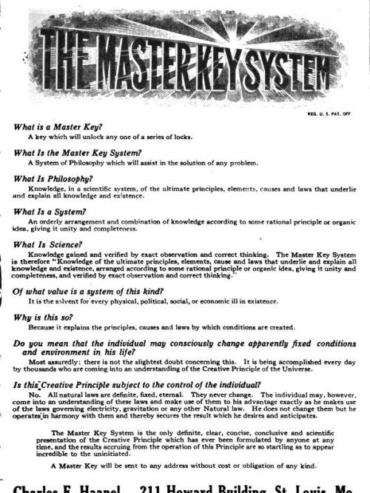
The Master Key System was not, in its original form, a book. It was a correspondence course — twenty-four weekly lessons mailed to subscribers who had enrolled in the program and agreed, implicitly, to progress through the material at the pace and in the manner Mr. Haanel specified. This structure was not accidental. It reflected Mr. Haanel’s deep conviction that what he was teaching could not be absorbed through casual reading, and it is a conviction that the text bears out at every turn. Each lesson built upon the preceding one in a way that made skipping ahead not merely inadvisable but effectively incoherent.
The system was, in the truest sense, a system — an interlocking architecture of ideas and practices, not a collection of inspirational chapters that could be dipped into at random.
The complete correspondence course ran for twenty-four weeks, and only upon completing it could a student obtain the bound volume. Mr. Haanel understood something that modern marketers would recognize immediately: he had created a commitment mechanism, a continuity program, and a graduated offer all in one. But his motives were not merely commercial. He genuinely believed, and the structure of the work supports the belief, that the lessons required time to take hold — that the philosophical content needed to be practiced before the next layer could be properly received.
What is the philosophy, exactly? It joins three traditions that are rarely united with any real intellectual rigor:
- philosophical idealism, in the tradition that holds that mind precedes and shapes material reality;
- a broadly spiritual understanding of the relationship between individual consciousness and a larger animating intelligence; and
- what Mr. Haanel presented as a scientific account of thought and its mechanisms.
Whether one accepts all three strands or merely one of them, the synthesis he attained was remarkable for its period and remains coherent in ways that most comparable works do not. The system explains not merely what to think but how to think: how to use the mind as an instrument of deliberate creation rather than passive reception.
And then there are the exercises. “The biggest part of The Master Key System is the exercises,” Anthony Raymond, the publisher who would revive the work more than half-a-century after it was written, has observed. “When you put them into practice, you become a very powerful person.”
The exercises in The Master Key System are unlike those found in virtually any other personal development text. They are concentration-based practices that require the student to develop genuine mental control — the ability to hold a single thought steadily, to exclude competing mental noise, and to direct attention with precision and duration. They begin simply, with stillness, and build progressively toward the kind of focused mental engagement that Mr. Haanel described as the precondition for productive and creative life. Completing them faithfully over the twenty-four-week period of the course is an undertaking that demands real discipline, and the students who have completed it — across generations and across the widest range of personal circumstances — have consistently reported that the effort repaid itself.
The Philosophy Beneath the System
The most persistent misreading of The Master Key System — a misreading that became culturally entrenched after the early 2000s — is the reduction of its philosophy to mere “positive thinking.” Mr. Haanel was not advocating magical cognition or the passive attraction of good outcomes through optimistic daydreaming. He was arguing something at once more demanding and more interesting: that concentrated, purposeful thought directed toward specific ends, combined with the kind of energetic, creative effort that clear mental focus makes possible, is the primary mechanism through which human beings shape their circumstances.
“Mr. Haanel’s philosophy includes action, work, hard work, true thinking, solving problems, focusing, and doing,” as Anthony Raymond has put it, in words that function as a corrective to decades of softened interpretation.
This is a crucial distinction. The system does not teach a person to wish. It teaches a person to think, which is a harder and more demanding enterprise than wishing — and a more productive one. The exercises enforce this distinction at every stage. They are not visualization exercises in the contemporary sense; they are concentration and comprehension exercises, practices designed to develop the capacity for sustained, directed, productive thought. The difference between the two is the difference between a person who imagines a result and a person who thinks rigorously toward one. Mr. Haanel was unambiguous about which of these he was teaching.
It is worth noting, too, that the work is genuinely philosophical in the technical sense — that it engages, seriously if accessibly, with questions about the nature of mind, the structure of reality, and the relationship between consciousness and the world. Mr. Haanel was not a philosopher by training, but he was a reader of breadth and discernment, and The Master Key System shows the influence of a tradition that ran from classical idealism through the New Thought movement of his own era, filtered through the sensibility of a man who had tested ideas against practical results for forty years.
The result is a document that rewards close reading and study in a way that most popular philosophy does not.
The Disappearance
The correspondence course format that had been The Master Key System‘s original delivery mechanism was also, in retrospect, the source of its eventual vulnerability. The infrastructure of early-twentieth-century correspondence education — the enrollment systems, the printing operations, the fulfillment apparatus, the community of practitioners and advocates who sustained the culture around these courses — did not survive the mid-century in any robust form. As that infrastructure eroded, The Master Key System lost the primary channels through which it had reached new readers.
The bound book edition persisted for a time, but its commercial distribution was never what could be called comprehensive, and as the decades passed, it became progressively harder to find through normal channels.
By the late 1980s and through the 1990s, the situation had become genuinely acute. The work was effectively unavailable in bookstores in any meaningful sense. What copies existed circulated in used book markets, passed from hand to hand among a small community of initiates who treated the text with something approaching reverence precisely because it was so difficult to obtain. The versions that did surface were often incomplete, altered in subtle but significant ways, or structurally compromised — pieces of the course separated from one another, individual lessons circulating without their context, abridgments that gutted the architectural logic of the whole. The Haanel who reached readers in this period was a fragmentary Haanel, a ghostly and partial version of the original.
Meanwhile, the ideas themselves continued to circulate, stripped of their source, absorbed into other works, diffused through the broader culture of self-improvement and personal development in ways that left Mr. Haanel’s name attached to nothing and no one.
This is the peculiar tragedy of the book’s middle period: the philosophy was everywhere, but the philosopher had been effectively erased.
The Long Shadow: Haanel’s Influence on American Thought
The extent of Mr. Haanel’s influence on the subsequent history of personal development literature is one of the genuinely underappreciated stories in American intellectual history. The most conspicuous single data point is Napoleon Hill, the author of Think and Grow Rich, one of the most widely read and lastingly influential personal development books ever published, whose core argument — that thought, directed toward a clear and specific purpose, is the primary mechanism of achievement — is recognizable as a development of Haanel’s foundational position. Hill’s acknowledgment of his intellectual lineage has been, in the minds of many scholars of the tradition, less than complete, and the relationship between The Master Key System and Think and Grow Rich remains a subject of ongoing and productive debate among those who have read both works with care. What is not seriously in dispute is that understanding Mr. Haanel’s work changes the way one reads Hill’s — and changes the way one reads the entire tradition that Hill helped establish.
The lineage extends further. The broad resonances between Mr. Haanel’s philosophy and the work of later figures — from the self-actualization tradition of the mid-twentieth century through the various strands of positive psychology and contemporary high-performance coaching — are not difficult to trace for anyone who has engaged seriously with the source material.
Tony Robbins, whose ideas about the relationship between mental state and external results owe a recognizable debt to the idealist tradition Mr. Haanel helped bring into the mainstream; Eckhart Tolle, whose sustained engagement with the nature of consciousness and its relationship to experienced reality draws from the same deep wells — these figures are comprehensible, and perhaps more interesting, when read against the Haanel background.
The 2006 film and book The Secret introduced an enormous new audience to ideas that circulate in the Haanel tradition, and its commercial success was extraordinary by any measure. It also, it must be said, presented those ideas in a form that Mr. Haanel himself would likely have found unrecognizable.
“I did not like The Secret when it was released,” Anthony Raymond has said without particular rancor. “I am grateful that it introduced many people to these ideas, though it also reduced them to something far goofier than Mr. Haanel intended.” This is a measured and accurate judgment. The Secrettook the idealist core of the tradition — the proposition that thought and reality are connected — and detached it entirely from the demanding, disciplined, action-oriented framework within which Mr. Haanel had embedded it, producing a philosophy of passive wishing that Mr. Haanel’s system, at every point, explicitly repudiated. The enthusiasm with which millions of people embraced The Secret is evidence of genuine hunger for the underlying ideas; the form in which those ideas were delivered was not the form Mr. Haanel would have sanctioned.
The Rediscovery

In 1999, Anthony Raymond came across The Master Key System and experienced what he has since described in unambiguous terms. “When I first read The Master Key System, I was gobsmacked,” he recalls. “I thought I had found the Rosetta Stone that would translate everything in my life — and I was not wrong.”
The discovery was not casual. Mr. Raymond was already a serious reader in the tradition of personal development and business success literature, and he had encountered, absorbed, and evaluated a substantial portion of that tradition before he came to Haanel. What distinguished the encounter with The Master Key System from everything that had come before was not merely the quality of the ideas but the architecture of their presentation.
“It was the first book that took the philosophical facet, the spiritual facet, and the scientific facet of life and put them all together in one wonderful thought philosophy,” he has explained — and that unity, that refusal to sacrifice any of the three dimensions to the other two, was precisely what Mr. Raymond had been looking for without knowing quite what form it would take.
The book was, at the time of this encounter, effectively unavailable. Good copies were difficult to obtain. Proper, complete, structurally intact editions did not exist in commercial circulation in any meaningful way. Mr. Raymond, who would go on to found Kallisti Publishing and build it into the authoritative modern home of Haanel’s work, recognized immediately both the importance of what he had found and the absence of any responsible publisher who was making it accessible. He decided to remedy that absence himself.
Kallisti Publishing began publishing The Master Key System in 1999. That date matters as it marks the beginning of the modern Haanel revival — not the beginning of Haanel’s influence, which had been operating in the background of American personal development culture for decades, but the beginning of the serious, sustained, editorially responsible effort to bring the work itself back to the reading public in a form worthy of its content.
Before Mr. Raymond’s intervention, there was no publisher doing this work with care, consistency, or authority. There were fragments, reprints of varying reliability, partial editions, and the intermittent enthusiasm of individual devotees. There was no home for Haanel in the modern publishing landscape.
Kallisti Publishing became that home.
Kallisti Publishing Becomes the Home of Haanel
In the quarter century since that 1999 publication, Kallisti Publishing has developed and maintained what is, by any serious measure, the most complete, most authoritative, and most editorially responsible body of Haanel publications in existence. This is not a claim made in a spirit of commercial boast; it is a statement of documented historical fact. No other publisher has invested the same sustained attention to the full scope of Mr. Haanel’s writing, to the recovery and presentation of his lesser-known works, and to the creation of companion materials designed to make his philosophy accessible and actionable for a contemporary readership.

Anthony Raymond’s relationship to this body of work is, in a real sense, that of a custodian as much as a publisher. He did not merely reprint the text and put it back on the market. He engaged with it, studied it, worked with it, created resources designed to deepen the reader’s experience of it, and gradually assembled the complete picture of what Mr. Haanel wrote across the full span of his authorial career. The result is an ecosystem of publications that represents something genuinely unusual in the self-help and personal development space: a publisher willing to treat a body of work as a serious literary and philosophical legacy, and to develop that legacy with commensurate seriousness and care.
For a reader serious about Haanel — not merely curious, not merely interested in a brief encounter with his most famous title, but genuinely committed to understanding and applying his philosophy — Kallisti Publishing is the beginning and the end of the conversation. Its editions are the best available. Its supplementary materials are indispensable. Its stewardship of the Haanel tradition has been both the originating force behind the modern Haanel revival and its most sustained and consequential expression.
The Works of Charles F. Haanel: An Annotated Survey
Mr. Haanel’s surviving body of work is broader and more varied than many readers expect. The Master Key Systemremains the centerpiece, though it stands within a larger constellation of books that deepen, extend, and sometimes redirect the same central concerns: thought, causation, character, health, magnetism, destiny, and the disciplined use of mind. What follows is a concise guide to the major works.
The Master Key System
The foundational text, originally issued as a twenty-four-week correspondence course and later collected in book form. It remains Mr. Haanel’s defining work and one of the most important documents in the history of personal development. Its union of philosophy and practice is what sets it apart. As Anthony Raymond has said, it is “both a complete philosophy and a complete practice.”
The New Psychology
A large and ambitious work that broadens the field opened by The Master Key System. Here Mr. Haanel moves across psychology, medicine, religion, metaphysics, and the workings of thought itself, building a wider intellectual foundation for the philosophy of attainment. It is one of his richest books and one of his best.
Mental Chemistry
One of Mr. Haanel’s most demanding works, Mental Chemistry attempts to describe the action of thought with something like scientific rigor. It is expansive, speculative, and often striking, treating mind not as ornament or abstraction but as a causal force that shapes conditions, habits, environment, and result. For serious readers, it is essential.
A Book About You
More personal in tone than Mr. Haanel’s major systematic works, this book turns directly toward the individual reader. It explores vibration, periodicity, imagination, emotion, destiny, and free will, asking not merely how the universe is ordered, but how a man may understand his place within it. It is one of Mr. Haanel’s most intimate and unusual books.
The Amazing Secrets of the Yogi
Written in collaboration with V. S. Perera of Ceylon, this book extends Mr. Haanel’s thought into explicitly Eastern territory. Breath, magnetism, energy, mastery, and the hidden capacities of mind and body are its central subjects. It is one of the strangest and most fascinating works in the Haanel canon, and far more substantial than its title may initially suggest.
Master Key Arcana
A collection of supplementary Haanel material and related writings that helps round out the larger picture. It is especially valuable for readers who have already spent time with the central books and want a fuller sense of the range and texture of Mr. Haanel’s thought.
The Garden of Eden and the Sex Problem
A surviving pamphlet and bibliographic curiosity, of greatest interest to serious students of Mr. Haanel and to those interested in the more obscure edges of his work. It belongs to the historical record, even if it is not the ideal point of entry for the general reader.
The Master Key Workbook
Not a Mr. Haanel original, but an important modern companion developed by Anthony Raymond. It is designed to help readers work through The Master Key System as a course of study rather than a text to be merely admired. Used properly, it turns reading into practice.
On attributed or unverified works
From time to time, titles such as Cause and Effect and Dream Power surface in the bibliographic folklore surrounding Mr. Haanel. At present, these belong to the realm of rumor, partial reference, and unresolved curiosity rather than established publication history. They are intriguing, though they should be approached with due caution.
The Marketer Hiding in Plain Sight
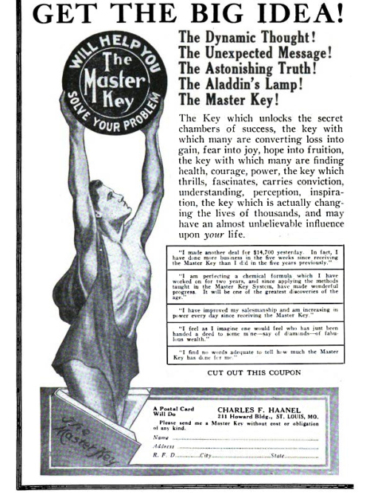
One of the most entertaining and underappreciated dimensions of Charles F. Haanel as a historical figure is the sophistication with which he marketed and distributed his work. The correspondence course model he employed was not merely an educational mechanism; it was a remarkably well-designed commercial system that modern marketers would recognize immediately and admire. Students enrolled in the course and received their lessons progressively — building investment, building engagement, building continuity. Only upon completing the course could a student obtain the bound volume, which functioned, in contemporary terms, as both a premium product and a graduation mark. Mr. Haanel understood presentation, positioning, and the psychology of progressive commitment in ways that were, for his era, extraordinarily sophisticated.
He also understood what would today be called lead magnets — materials designed to introduce potential students to his philosophy at low friction and low cost, creating the appetite that the full course then satisfied.
The entire apparatus of his publishing operation reflected the thinking of a man who had spent decades building businesses and understood that the quality of what you offer is not sufficient; the structure through which you offer it shapes whether it reaches the people it could benefit.
This dimension of Mr. Haanel’s career deserves more attention than it typically receives, both because it is interesting in its own right and because it illuminates the seriousness with which he approached the entire enterprise of bringing his ideas to the world.
Mythology, Rumors, and the Aura of the Work
Every book of genuine consequence accumulates a mythology, and The Master Key System is no exception. Two stories in particular have pursued the work for decades, and they are worth examining — both because they say something true about the book’s reputation and because they say something false about its history that should be corrected.
The Bill Gates Rumor

The first is the story that Bill Gates, the co-founder of Microsoft and for many years the richest person on earth, read The Master Key System and credited it as an influence on his success. The story circulates with remarkable persistence in Haanel communities online and in the broader self-help culture.
It is, so far as can be determined from available evidence, unverified. There is no documented instance of Mr. Gates making such a claim in any form that can be reliably traced.
This does not mean the story is impossible — the book’s ideas are genuinely compatible with a certain kind of entrepreneurial drive, and a reader of Mr. Gates’s known breadth and appetite might well have encountered it. But the story functions primarily as myth — a culturally useful story that says something true about the kind of book this is, even if it may not say something true about this particular reader.
Haanel’s work is the kind of book that people who accomplish extraordinary things might plausibly find useful. That is the truth the Gates story encodes.
Banned by the Church
The second persistent story is that The Master Key System was “banned by the church” and suppressed by religious authority because of the threat its ideas posed to orthodoxy. This is almost certainly not accurate in any formal, institutional sense. There is no documented evidence of an ecclesiastical prohibition.
What seems more likely is that the book’s reputation for challenging conventional religious thinking — its assertion that each individual consciousness is a point of access to divine intelligence, without the need for clerical mediation — generated controversy in some quarters and that this controversy, filtered through the romance of persecution, became the myth of suppression.
The mythology is understandable. Books that threaten established ways of thinking attract the story of suppression as naturally as ambitious men attract the story of enemies. The fact that the church ban almost certainly did not happen in any official sense does not diminish the book’s genuine intellectual radicalism, which was real.
The Complete Master Key Course: The Work in Full
For the reader who has arrived at the point of wishing to engage seriously with Mr. Haanel’s philosophy as a whole — not merely to sample it, not to acquire a single title and consider the matter closed, but to immerse in the full body of work and emerge with a comprehensive understanding of what Mr. Haanel taught and how he taught it — Kallisti Publishing has assembled the Complete Master Key Course.
The Course is, in the most literal sense, weighty: the physical edition, when shipped, runs to more than five pounds of books — a fact that communicates something about the scope of what has been assembled. It contains all of Mr. Haanel’s major works, collected and presented in authoritative editions, along with the companion and supplementary materials that Mr. Raymond and Kallisti Publishing have developed over twenty-five years of custodianship.
It is, in short, everything — the whole picture, assembled by the publisher that knows this territory better than any other, and presented with the seriousness that the subject deserves.
There is no better single source for the complete Haanel. There is no edition more carefully assembled, no publisher more deeply invested in the integrity of the material, no resource more likely to give a serious reader what they need to engage with this tradition at the level it rewards.
The Complete Master Key Course is the fulfillment of the promise that Anthony Raymond made to himself and to the reading public in 1999, when he decided that this extraordinary work needed a home and committed himself to building one.
A Legacy Revived
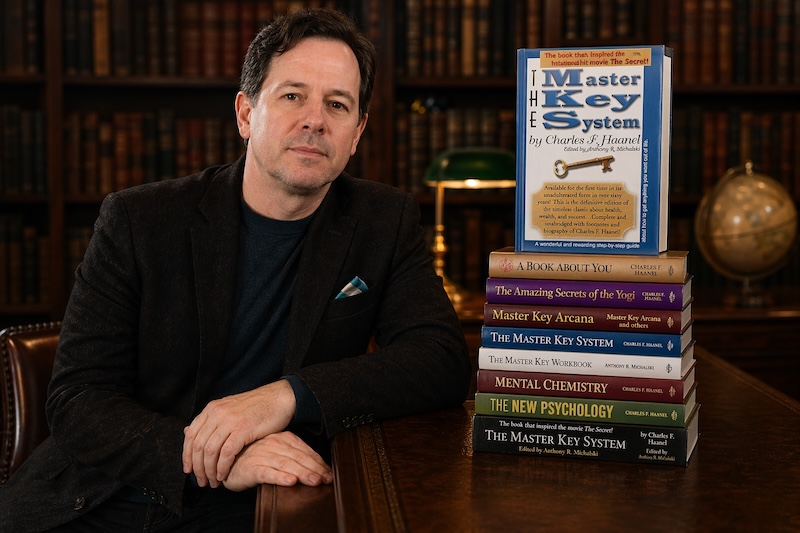
Charles F. Haanel spent his life thinking seriously about what it means to use one’s mind well, and building businesses that demonstrated he had found some useful answers. He organized his ideas into a system that he believed any person, regardless of background or circumstance, could apply to any life.
“Haanel is for everybody who wants to be better,” Anthony Raymond has said — simply, directly, without elaboration, in the manner of a man who has spent twenty-five years thinking about this and has arrived at the version of the truth that survives compression. The remark is, in its plainness, a small masterpiece of editorial judgment.
Mr. Haanel’s burial in Bellefontaine Cemetery in 1949 seemed, for a long time, like the burial of the work as well. The infrastructure that had sustained it collapsed. The cultural apparatus that might have preserved it in living circulation did not materialize. The ideas survived — dispersed, unattributed, filtered through the work of successors who built upon the foundation without marking it — but the source went dark. For fifty years, the philosopher who had most systematically explored the relationship between focused thought and achieved result was, for all practical purposes, a ghost.
Then Anthony Raymond found the book. And then he decided the world should have it back.
That decision, made in 1998 and sustained through every year since, is the reason you are reading this page, the reason The Master Key System is available today in authoritative, complete, carefully prepared editions, and the reason the name Charles F. Haanel has been rescued from the footnotes and restored to the prominence it deserves.
Kallisti Publishing did not merely republish a forgotten text. It brought a philosopher back from the dead. It gave a buried system new life. And in doing so, it gave an enormous number of people access to something rare: a work of genuine intellectual substance that also, when applied with the seriousness its author intended, actually works.
The book is available. The course is assembled. The home of Haanel is open.
Kallisti Publishing Inc. has been the home of Charles F. Haanel’s work since before the company was founded — The Master Key System was the first book published by the nascent publisher. The Complete Master Key Course, along with all of Mr. Haanel’s titles, is available through Kallisti Publishing at ReadKP.com.
1 Comment
Comments are closed.