
Troy, New York. 1813.
The Hudson runs cold and steady past a row of packing houses, and the air carries salt, woodsmoke, and the iron tang of the trade. The river is the reason the town exists. Boats come up loaded and go down heavier, and a young country at war moves much of what it needs along this very water.
Inside one of those houses, men work in rhythm. They cut. They salt. They press the meat into oak barrels, set the lids, and stamp each one before it rolls down to the dock.
The barrels are bound for soldiers.
You see, the country is at war again — and an army downriver needs feeding.
Samuel Wilson owns the packing house, and he moves among his workers like a favorite relative at a family table. He hires half the young men in town, and he knows every name.
“Good morning, Joseph,” Sam will say.
And they answer in kind, with a fond name they have come to use for him — because Sam is honest to a fault and cheerful past all reason, and everyone in Troy likes him and trusts him.
A Long Walk to Troy
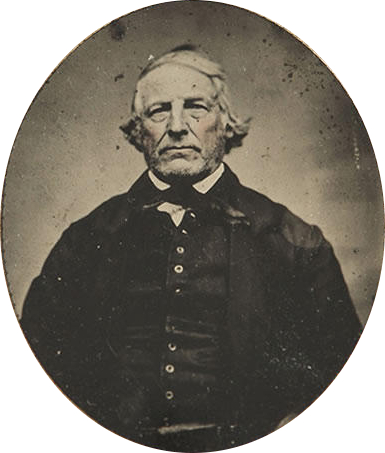
Sam Wilson was born in Massachusetts in 1766, in a village near Boston, and raised in the hills of Mason, New Hampshire.
At barely fourteen he joined the Continental Army — a young boy in a young country’s fight — and they handed him the humblest of duties: tend the cattle, guard the herd, slaughter and pack the meat that kept the soldiers fed. He learned the work with his own two hands, in the cold, while history happened around him. He learned how an army eats. He learned that meat travels in barrels, that salt is the difference between food and waste, and that a soldier far from home lives or starves on the care a stranger took weeks earlier.
That lesson would matter more than he could have guessed.
When the war ended, Sam wanted a future. So at twenty-two he and his older brother Ebenezer walked — on foot, the whole way — from New Hampshire to a small river town called Troy. A growing nation was opening up along its rivers, and the brothers meant to grow with it.
There, they built a business from the ground up — and that is meant literally. The clay along the Hudson made fine brick, and Sam fired the first native bricks the town ever owned; some of them still hold up old Troy buildings today. From bricks the brothers moved into the trade Sam knew best, and the firm of E. & S. Wilson became one of the busiest meatpacking operations on the upper Hudson.
Sam took an oath as town assessor, then as the man who kept the roads. He married. He raised his children. He gave to the town and the town gave back. He grew into exactly the sort of citizen a young republic runs on — useful, trusted, woven into the daily life of a place that needed him.
And the fond name the town had for him followed him everywhere he went.
Beef for an Army
Then came 1812, and another war with the British.
The army needed meat, and it needed mountains of it. An army in the field runs on its stomach, and in 1812 a full stomach meant salt beef and salt pork sealed tight in oak — the only food that would survive a long haul to a distant camp. Whoever could pack it cleanly, and by the thousands of barrels, held something close to the keys to the war effort.
The Secretary of War handed a supply contract to a New York man named Elbert Anderson, who in turn needed packers he could trust. Sam Wilson and his brother won the work: two thousand barrels of pork, three thousand of beef, bound for the troops across a single year.
The government named Sam an official meat inspector, charged with seeing that every barrel met the standard before it left the dock. The whole arrangement rested on one quiet thing — trust. Trust that the man stamping the lid had done the work right. Sam had spent his life earning exactly that.
So they stamped each barrel to mark it as government property.
The contractor’s initials came first — E. A., for Elbert Anderson. Then two more letters, for the nation those barrels would feed: U. S.
The barrels rolled onto boats and floated downriver to a great camp at Greenbush, across the Hudson, where six thousand soldiers waited. Many of them were Troy men. Many of them knew Sam Wilson by sight. And every one of them knew exactly whose hands had packed that beef.
One day, a soldier looked at the letters burned into the wood and asked a simple question.
“What do those letters U.S. on the barrels stand for?”
A Legend is Born

A man standing nearby — a fellow Troy man — grinned and gave the answer that would outlive every soul in that camp.
“Why, that’s Uncle Sam,” he said. “Uncle Sam Wilson. He’s the one feeding us.”
It was a joke. U. S. meant the United States, plain as the morning. Yet these men knew Sam Wilson, and they knew the warm name the town had always used for him, and the joke fit far too well to let go.
The beef was Uncle Sam’s.
The barrels were Uncle Sam’s.
Soon every crate and wagon and musket stamped with those two letters belonged, in the soldiers’ easy humor, to Uncle Sam.
The men carried the name home. The newspapers caught it. And a scrap of barroom wordplay began its long climb — from a meatpacker in Troy, to the army, to the government itself, until a whole nation answered to it.
The man himself wore a plain coat and a plain face.
The white beard, the star-spangled suit, the tall hat and the pointing finger — illustrators dreamed all of that up decades later. In the 1860s and 1870s, the cartoonist Thomas Nast gave Uncle Sam the goatee and the stars-and-stripes coat the country now pictures without thinking. Then, in 1917, an illustrator named James Montgomery Flagg painted the version that fixed the figure in the world’s eye forever — a stern Uncle Sam leaning out of the frame, finger leveled at the viewer, beneath the words I Want YOU for U.S. Army. The government printed over four million copies of it during the First World War. Flagg, pressed for time, had used his own face for the model.
Artists gave Uncle Sam his face.
Yet it was a simple man from Troy, New York — a good man named Samuel Wilson — who gave him his name. That is the account Troy has told for two centuries, and the nation made it official at last: in 1961, the United States Congress passed a resolution saluting Samuel Wilson of Troy, New York, as the progenitor of America’s national symbol — Uncle Sam.
A meatpacker. A barrel of beef. Two letters and a friendly joke.
And that affectionate name still belongs to the whole United States.
Every Part Counts
America was built by founders, soldiers, farmers, printers, merchants, builders, inventors, shopkeepers, publishers, suppliers, families, strivers, and countless others whose names seldom reach the page.
Some people receive statues.
Some receive footnotes.
Some carry a spear across the stage for a single scene.
Yet the scene still needs them.
Samuel Wilson honored a contract, supplied troops, and played his part in the way available to him. He reached for nothing grand. He simply did good work and put his name behind it. And his work became part of something far larger than the barrels leaving his shop — larger than he ever lived to see.
That remains one of the great privileges of life in this country.
Each of us has opportunity here.
Each of us also has responsibility here.
We may never know how far our work, our choices, our character, and our contribution will reach. But each part we play adds something to the American tapestry.
And that is a beautiful thing to remember.
Every Fourth of July, when the parades roll and that tall figure in the star-spangled hat points out from a poster or a float, give him a nod. He began as a real man with a real trade and a real reputation for doing right.
He was every American who ever did good work and signed his name to it.
He still is.
Because he is, by the Grace of God, you and me.
—
If you liked this article, then you’re going to love The ATTAINER — the weekly email that we send that is your weekly invitation to think bigger, act bolder, and attain more. You will discover useful ideas through remarkable stories, books, and opportunities gathered from across the Kallisti Publishing, International Wealth Success (IW$), and Charles F. Haanel and the Master Key System worlds. Thank you for joining us as we move forward boldly . . .
SUBSCRIBE TO THE ATTAINER NOW!
